
Did you know that John Edward Champney (1846-1929), the benefactor of funds to build Beverley’s Public Library and Art Gallery, and now honoured in the new name of our Champney Treasure House, had a very close call on his life whilst living and working in Halifax?
In 1872, Champney, then aged 26, was working in Halifax as a Director at his Uncle’s worsted manufacturing company Messrs James Akroyd & Sons Limited. His uncle was Colonel Edward Akroyd, MP, a highly philanthropic and wealthy individual. During the mid 1800s, the firm was one of the largest worsted manufacturers in Britain, employing over 2000 workers.
A startling incident was reported across several West Riding newspapers describing the chilling case of James Whitehead, a 51-year-old damask weaver, who had a severe grievance with John Edward Champney, his former employer. The story differs slightly across the newspaper reports, however the following key events can be deduced.
At 3:30pm on the 15 November 1872, Champney was leaving Bankfield House (the home of Edward Akroyd, which became the Bankfield Museum in 1887), after having lunch. This was a regular occurrence for Champney, and Whitehead seemed to be aware of his whereabouts at this time as he was loitering across the road outside the Bankfield House gates. Although Champney saw him, he then proceeded to follow him down Haley Hill, even waiting whilst Champney paid a quick visit to a school. When Champney left the school yard to head back to the office at Cross Hills, Whitehead was spotted crouching in a doorway.

As Champney turned to walk past the Coach and Horses Inn next to Bankfield Mill, he heard the explosion of a firearm and the painful feeling of being struck from behind. According to the newspaper reports, Champney then confronted his attacker, and in self-defence, proceeded to hit Whitehead on the shoulder and head with his umbrella, which broke during the process. He then escaped to the safety of the house of Mr Stansfield and reported the attack. Whitehead was immediately brought into custody and was found to be drunk on liquor.
Miraculously, Champney survived the attack but was bleeding. His thick overcoat reduced the impact and he sustained only minor injuries. According to the Manchester Evening News, he was examined at Mr Bramley’s surgery to find that “the shot penetrated his overcoat, coat, vest, braces, shirt, and flannel shirt, wounding him in two places.” The bullets were iron slugs of low quality, according to the Leeds Times.
The incident had two key witnesses, including a girl named Harris who saw the shooting itself. Thomas Best, a carpet weaver, stated that Whitehead had shown him a loaded pistol. When asked about his intent, he said to Best:
“I am going to shoot Champney”
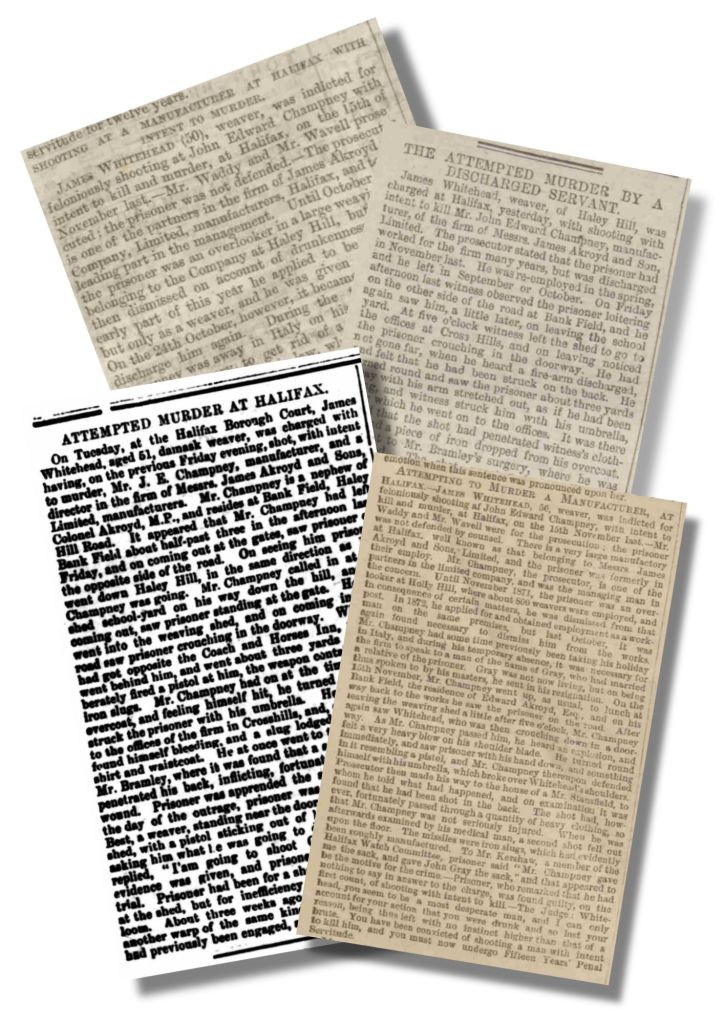
What were his motivations? Reports suggest that Whitehead harboured a grievance after multiple employment dismissals by Messrs James Ackroyd & Sons Limited. Whitehead had worked for the firm for many years and was an overlooker (supervisor) in a weaving shed at Haley Hill, but was dismissed for drunkenness in October 1871. He was re-engaged with the firm a few months later as a weaver in a loom shed, but on 24 October 1872 was dismissed a second time for refusing to take orders.
In addition to Whitehead’s employment problems, his brother-in-law, John Gray, also resigned to escape a workplace investigation into objectionable conduct. It was mentioned that Champney was holidaying in Italy at the time of Gray’s resignation. Whitehead confirmed his motivations to Mr Kershaw, a member of the Halifax Watch Committee:
“Mr Champney gave me the sack, and gave John Gray the sack.”
At the Leeds Assizes court in December 1872, Whitehead was not defended, and Mr Waddy and Mr Wavell were for the prosecution. He was described by the Judge as “a most desperate man… drunk and so lost your reason being thus left with no instinct higher than that of a brute”.
Whitehead was found guilty and sentenced to 15 years penal servitude. According to the Sheffield Independent newspaper:
“Mr Champney had escaped by a hair’s breadth”
It is now 152 years since this event, and it is intriguing to think that had Whitehead succeeded, Beverley would not have the pleasure of enjoying the Champney Treasure House in the form it is in today. With its Grade II listed Library and Art Gallery building, and Champney’s generous bequest of artwork and books, his gift to the town he was born in forms a special legacy for future generations.


 Archives blog